
The Prophetic Strategic Preparation Model (PSPM): A Sequential Framework of Spiritual Leadership Formation in Surah Al-Muzzammil
Published 2026-05-09
Keywords
- Spiritual Leadership,
- Social Network Analysis,
- Qur’anic Topology,
- Leadership Formation,
- Surah Al-Muzzammil
Copyright (c) 2026 Muhammad Aamir Ali, Nazish Aamir (Author)

This work is licensed under a Creative Commons Attribution 4.0 International License.
Abstract
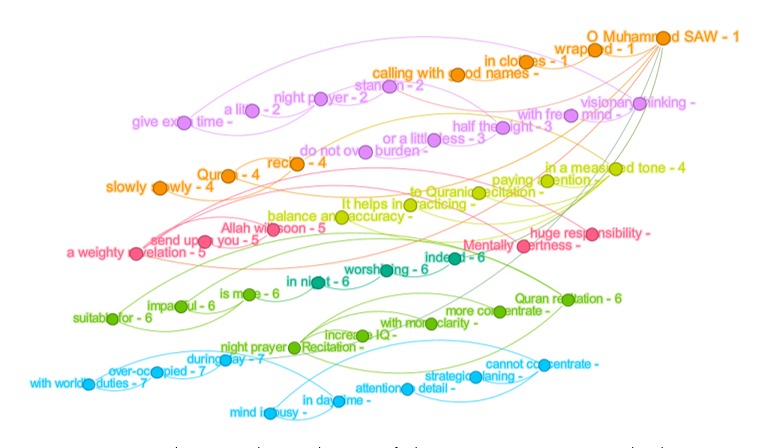
Purpose – This study aims to examine the structural process of spiritual leadership formation in The Qur'an through an analysis of Surah Al-Muzzammil (verses 1–7). The research addresses the methodological gap in previous Qur’anic leadership studies, which generally emphasize thematic interpretation without modeling the relational dynamics among spiritual constructs. The study proposes a sequential framework called the Prophetic Strategic Preparation Model (PSPM) to explain how spiritual discipline shapes prophetic leadership readiness. Design/methods/approach – The study employs Social Network Analysis (SNA) to operationalize Qur’anic concepts as interconnected relational nodes. A total of 44 thematic nodes were extracted from the selected verses and coded into an adjacency matrix. Centrality measures, including closeness, harmonic closeness, betweenness centrality, and eccentricity, were calculated using Gephi software, alongside modularity-based clustering analysis. Findings – The findings reveal a layered relational topology in which identity anchoring functions as the central structural hub, nocturnal discipline acts as a mediating mechanism, measured recitation serves as cognitive calibration, and responsibility emerges as a downstream construct dependent on prior spiritual preparation. Five major modular clusters were identified, representing spiritual discipline, cognitive structuring, responsibility internalization, optimization outcomes, and strategic temporal engagement. Research implications/limitations – The study is limited to Surah Al-Muzzammil (verses 1–7) and focuses exclusively on network-based structural interpretation. Future studies may expand the dataset to other Qur’anic passages and integrate qualitative exegetical comparisons. Originality/value – This research contributes methodologically by demonstrating the applicability of SNA in Qur’anic studies and theoretically by introducing PSPM as a systems-based framework for spiritual leadership formation grounded in Islamic scripture.
References
- Quran, 73:1-7.
- Quran Surah Ash-Shu'ara, 26:69-104.
- Quran Surah Hud, 11:25-94.
- Quran, 73:6.
- Quran, 73:4.
- Quran, 73:5.
- N. M. Alsharari and M. S. Aljohani, "The benchmarking implementation and management control process as influenced by interplay of environmental and cultural factors: institutional and contingency perspectives," Benchmarking: An International Journal, vol. 31, no. 9, pp. 3327-3348, 2024.
- R. Amoako, Y. Jiang, M. F. Frempong, S. Tetteh and S. S. Adu-Yeboah, "Examining the effect of organizational leadership, organizational structure, and employee technological capability on the success of electronic human resource management," Sage Open, vol. 12, no. 2, 2022.
- M. Anesa, A. P. Spee, N. Gillespie and F. J. Petani, "Reassessing moral legitimacy in times of instability," Journal of Management Studies, vol. 61, no. 3, pp. 857-887, 2024.
- M. Audi and H. Yu, "Strategic value creation through corporate social responsibility adoption for sustainable financial performance," Journal of Policy Options, vol. 7, no. 4, pp. 14-21, 2024.
- Quran, 73:1.
- Quran, 73:2.
- Quran, 73:3.
- Quran, 73:7.