
Challenges of Addressing Money Laundering As A Threat To National Security: A Study of Nigeria and Senegal
Published 2026-05-09
Keywords
- Money Laundering,
- National Security,
- Anti-Money Laundering,
- AML/CFT,
- Nigeria
- Senegal. ...More
Copyright (c) 2026 Umar Sanda Babashani (Author)

This work is licensed under a Creative Commons Attribution 4.0 International License.
Abstract
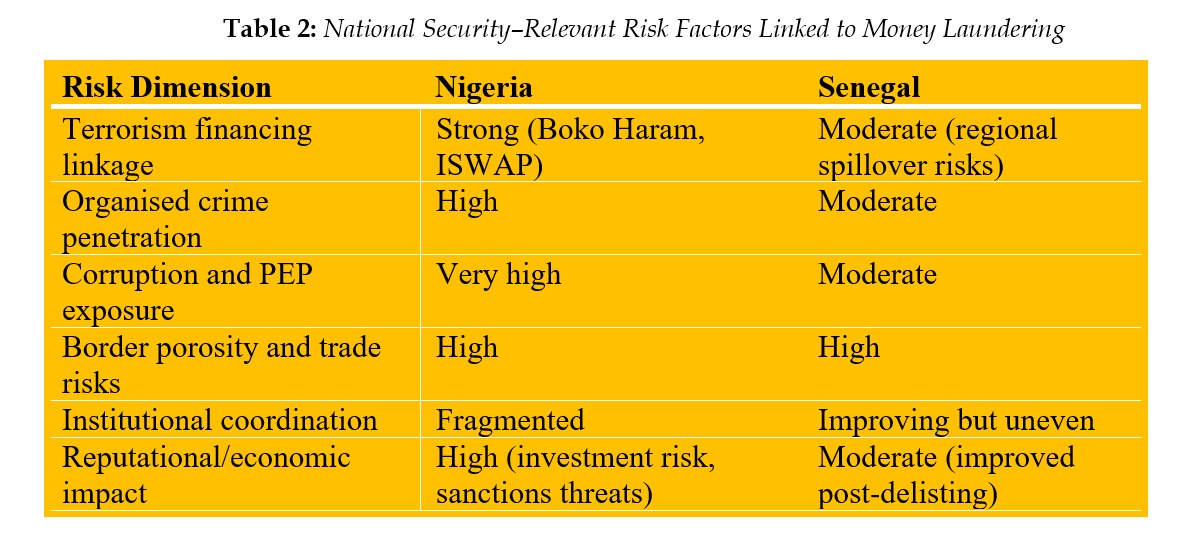
Purpose – This study examines the challenges of addressing money laundering as a threat to national security in Nigeria and Senegal. The research was undertaken to assess how institutional weaknesses, regulatory fragmentation, and technological adaptation by criminal networks undermine the effectiveness of anti-money laundering and counter-terrorist financing (AML/CFT) frameworks in both countries. Design/methods/approach – The study adopts a qualitative comparative research design based exclusively on secondary data. Data were collected from FATF, GIABA, UNODC, national legislation, institutional reports, and peer-reviewed literature. Institutional Theory served as the principal analytical framework, complemented by Systems Theory, while qualitative thematic and comparative analyses were employed to evaluate legal frameworks, institutional coordination, enforcement practices, and national security implications. Findings – The findings reveal that Nigeria records high volumes of AML investigations and Suspicious Transaction Reports (STRs), yet conviction rates remain disproportionately low due to institutional fragmentation, political interference, and weak inter-agency coordination. Senegal demonstrates relatively stronger institutional coherence following FATF delisting, but enforcement effectiveness remains constrained by limited capacity and low detection rates. Both countries remain vulnerable to cash-based laundering systems, porous borders, and emerging digital and cryptocurrency channels. Research implications/limitations – The study relies solely on secondary data and focuses on two West African countries, which may limit the generalisability of findings to other regions. Variations in institutional reporting standards and data availability also affected comparative assessment. Originality/value – This study contributes to the literature by positioning money laundering as an institutional and systemic national security challenge rather than merely a financial crime issue. It provides comparative insights into AML governance in West Africa and highlights the need for institutional consolidation, technological upgrading, and regional cooperation.
References
- Adetunji, A., & Oyebade, A. (2021). Challenges of combating money laundering in Nigeria: Institutional perspectives. African Journal of Criminology and Justice Studies, 15(2), 112–130.
- CENTIF. (2023). Annual report 2023. Cellule Nationale de Traitement des Informations Financières, Senegal. Retrieved from https://www.centif.sn
- CENTIF. (2024). Annual report 2024. Cellule Nationale de Traitement des Informations Financières, Senegal. Retrieved from https://www.centif.sn
- Demetis, D. (2008). The anti-money laundering system: A systems theory perspective (Doctoral thesis). London School of Economics and Political Science.
- Diallo, M. (2023). Institutional and regional challenges of anti-money laundering in Senegal. West African Journal of Security Studies, 8(1), 78–96.
- Economic and Financial Crimes Commission. (2019). Annual report 2019. Abuja: EFCC. Retrieved from https://www.efcc.gov.ng
- Economic and Financial Crimes Commission. (2020). Annual report 2020. Abuja: EFCC. Retrieved from https://www.efcc.gov.ng
- Economic and Financial Crimes Commission. (2021). Annual report 2021. Abuja: EFCC. Retrieved from https://www.efcc.gov.ng
- Ekwueme, A., & Chukwu, F. (2024). Socio-economic and enforcement challenges in combating money laundering in Nigeria. International Journal of Financial Security, 11(3), 25–47.
- FATF. (2020). Anti-money laundering and counter-terrorist financing measures: Senegal mutual evaluation report. Financial Action Task Force. Retrieved from https://www.fatf-gafi.org
- FATF. (2021). Anti-money laundering and counter-terrorist financing measures: Nigeria mutual evaluation report. Financial Action Task Force. Retrieved from https://www.fatf-gafi.org
- Financial Action Task Force. (2018). Anti-money laundering and counter-terrorist financing measures: Senegal mutual evaluation report. Paris: FATF. Retrieved from https://www.fatf-gafi.org
- Financial Action Task Force. (2020). Money laundering and terrorist financing threats and vulnerabilities. Paris: FATF. Retrieved from https://www.fatf-gafi.org
- Financial Action Task Force. (2023). Jurisdictions under increased monitoring. Paris: FATF. Retrieved from https://www.fatf-gafi.org
- Financial Action Task Force. (2024a). Money laundering and terrorist financing risk assessment outlook. Paris: FATF. Retrieved from https://www.fatf-gafi.org
- Financial Action Task Force. (2024b). Mutual evaluation of Senegal: Anti-money laundering and counter-terrorist financing measures. Retrieved from https://www.fatf-gafi.org/en/publications/High-risk-and-other-monitored-jurisdictions/Increased-monitoring-october-2024.html
- Financial Action Task Force. (2025a). Jurisdictions under increased monitoring – Nigeria. Retrieved from https://www.fatf-gafi.org/en/countries/detail/Nigeria.html
- Financial Action Task Force. (2025b). Anti-money laundering and counter-terrorist financing technical compliance report. Retrieved from https://www.fatf-gafi.org
- GIABA. (2025). West African regional anti-money laundering and counter-terrorist financing assessment. Retrieved from https://gazettengr.com/giaba-calls-for-stronger-regional-cooperation-to-tackle-financial-crimes-in-west-africa/
- Heylighen, F., & Joslyn, C. (1992). What is systems theory? In Principia Cybernetica Web. Retrieved from https://pespmc1.vub.ac.be/SYSTHEOR.html
- Kohnert, D. (2024). Illicit financial flows and AML implementation in sub-Saharan Africa: Evidence from Nigeria and Senegal. African Economic Review, 36(4), 211–235.
- Kutigi, M. (2024). Legal and regulatory challenges in Nigeria's anti-money laundering framework. Nigerian Law Journal, 18(1), 33–55.
- Meyer, J. W., & Rowan, B. (1977). Institutionalized organizations: Formal structure as myth and ceremony. American Journal of Sociology, 83(2), 340–363. https://doi.org/10.1086/226550
- Ministry of Economy UAE. (2025). National risk assessment of money laundering and terrorist financing. Abu Dhabi: Government of the United Arab Emirates. Retrieved from https://www.economy.gov.ae
- National Crime Agency. (2024). National strategic assessment of serious and organised crime. London: NCA. Retrieved from https://www.nationalcrimeagency.gov.uk
- Ndao, P. (2025). Fintech, cryptocurrencies, and money laundering risks in Senegal. Journal of Digital Finance in Africa, 4(1), 33–52.
- Ndikumana, L. (2015). Illicit financial flows and trade-based money laundering in Africa. Journal of African Development, 17(2), 45–70.
- Niang, C. (2020). Money laundering in Senegal: Regulatory and judicial challenges. Senegalese Journal of Legal Studies, 6(2), 59–78.
- Nigeria Financial Intelligence Unit. (2016). National risk assessment of money laundering and terrorist financing. Abuja: NFIU. Retrieved from https://www.nfiu.gov.ng
- North, D. C. (1990). Institutions, institutional change and economic performance. Cambridge University Press.
- Okoye, V. O., Chinasa, O. R., & Kenechukwu, J. N. (2022). The menace of money laundering in Nigeria: Issues, challenges and way forward. International Journal of Advanced Research in Innovative Discoveries in Engineering and Applications, 8(4), 101–119.
- Sanction.io. (2025). Money laundering risks and predicate offences in Nigeria. Retrieved from https://sanction.io
- Thiam, I. (2022). Trade-based money laundering in Senegal: Challenges and prospects. West African Journal of Economics and Finance, 10(2), 71–89.
- U.S. Department of the Treasury. (2024). National strategy for combating terrorist and illicit financing. Washington, DC: U.S. Department of the Treasury. Retrieved from https://home.treasury.gov
- United Nations Office on Drugs and Crime. (2023). Global study on illicit financial flows. Vienna: UNODC. Retrieved from https://www.unodc.org
- von Bertalanffy, L. (1968). General system theory: Foundations, development, applications. George Braziller.
- Young, R. (2023). Offshore financial centres and money laundering in Nigeria: Implications for national security. Journal of International Banking Regulation, 9(3), 55–73.