
Published 2026-05-09
Keywords
- Shari’ah,
- Teachings,
- Societal Crimes,
- Islamic Civilization,
- Justice
- Environmental Stewardship ...More
Copyright (c) 2026 Bello Ali, Lawan Abdullahi Muhammad, Maunde Muhammad Usman, Abdulmumini Bawuro Manga, Murjanatu Ismail Agwaru (Author)

This work is licensed under a Creative Commons Attribution 4.0 International License.
Abstract
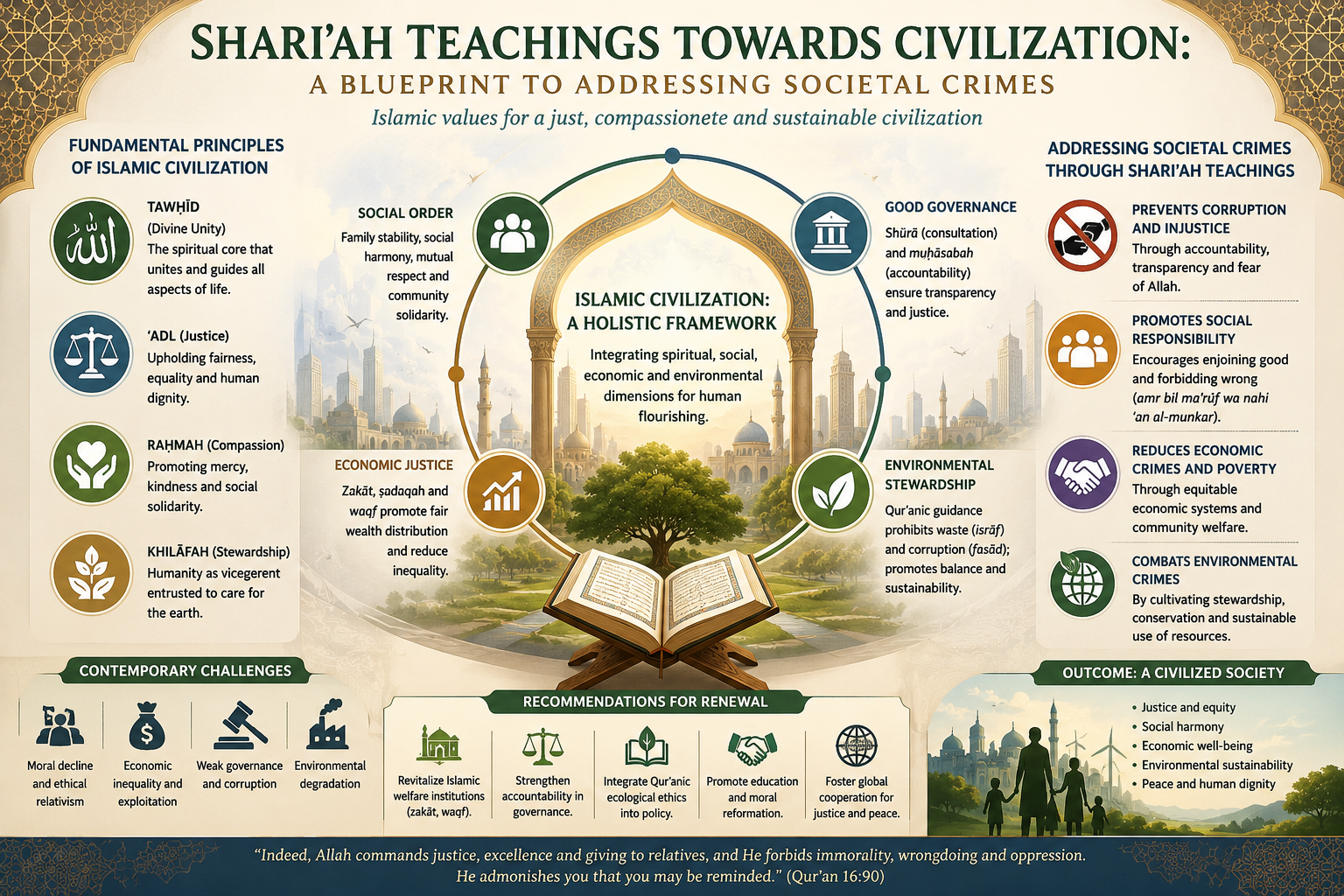
Purpose – This study examines how Shari’ah teachings within Islamic civilization provide a comprehensive framework for addressing societal crimes and contemporary social crises. The paper responds to the growing challenges of moral decline, economic inequality, governance failures, and environmental degradation by exploring the relevance of Islamic ethical principles such as tawḥīd (divine unity), ʿadl (justice), raḥmah (compassion), and khilāfah (stewardship). It argues that Islamic civilization offers a timeless model for promoting justice, social harmony, and sustainable development. Design/methods/approach – The study adopts a qualitative and analytical research methodology using a descriptive-analytical design. Data were collected through documentary analysis of the Qur’an, classical Islamic scholarship, and contemporary academic literature. Thematic and content analysis were employed to examine the application of Shari’ah teachings to issues relating to societal crimes, governance, welfare, and environmental sustainability. Findings – The findings reveal that Islamic civilization integrates spiritual, social, economic, and environmental dimensions into a unified moral framework. Shari’ah teachings promote accountability, moderation, equality, and consultation (shūrā) as safeguards against corruption and injustice. Economic institutions such as zakāt, ṣadaqah, and waqf support equitable wealth distribution and social welfare, while Qur’anic environmental ethics discourage wastefulness (isrāf) and corruption (fasād). The study further finds that Islamic principles provide preventive and transformative approaches to societal crimes through moral reform, social responsibility, and ethical governance. Research implications/limitations – The study is limited to qualitative analysis based on documentary sources and does not include empirical fieldwork. Its conclusions are primarily interpretive and focused on Islamic civilizational thought, which may limit broader comparative application. Originality/value – This study contributes to contemporary discourse by positioning Islamic civilization as a holistic framework for crisis management, ethical governance, crime prevention, and environmental stewardship. It highlights the enduring relevance of Shari’ah principles in addressing modern societal challenges while offering a value-based alternative to secular approaches to civilization and development.
References
- I. R. Al-Faruqi, The essence of Islamic civilization (Occasional Paper No. 21). International Institute of Islamic Thought, 2013.
- K. U. Sulaiman, Islamic civilization: Meaning, origin and distinctive characteristics. In M. Haque, K. U. Sulaiman, B. Soualhi, & S. Arif (Eds.), Islam, knowledge and civilization (pp. xx–xx). IIUM Press, 2010.
- Qur’an, Surah Al-Baqarah 2:30.
- Qur’an, Surah Al-An'am 6:165.
- M. Hifdil, Islam and civilization (analytical study on the history of Islamic civilization). Jurnal Al-Insyiroh: Jurnal Studi Keislaman, 5(1), 2019, 22–39.
- S. M. N. Al-Attas, Islam and secularism. International Institute of Islamic Thought and Civilization (ISTAC), 1993. https://traditionalhikma.com
- D. M. Zakariya, Development of Islamic thought and civilization in historical perspective. Studia Religia: Jurnal Pemikiran dan Pendidikan Islam, 4(1), 2020, 167-177.
- K. U. Sulaiman, Islamic civilization: Meaning, origin and distinctive characteristics. In M. Haque, K. U. Sulaiman, B. Soualhi, & S. Arif (Eds.), Islam, knowledge and civilization (pp. xx–xx). IIUM Press, 2010.
- Qur’an, Suratul Ibrahim 14:1.
- I. R. Al-Faruqi, The essence of Islamic civilization (Occasional Paper No. 21). International Institute of Islamic Thought, 2013.
- J. Farooqui, Civilization in an Islamic perspective. Journal of Islam in Asia, Special Issue, 1, 2011, 409-425.
- K. U. Sulaiman, Islamic civilization: Meaning, origin and distinctive characteristics. In M. Haque, K. U. Sulaiman, B. Soualhi, & S. Arif (Eds.), Islam, knowledge and civilization IIUM Press, 2010, xx–xx.
- M. Hifdil, Islam and civilization (analytical study on the history of Islamic civilization). Jurnal Al-Insyiroh: Jurnal Studi Keislaman, 5(1), 2019, 22–39.
- E. A. K. Alhashmi, The principles upon which Islamic civilization was built: Countering violent extremism and terrorism. Al-Wijdán: Journal of Islamic Education Studies, 8(1), 2023, 10–29. https://ejournal.uniramalang.ac.id/index.php/alwijdan
- F. Rahman, Islam and modernity: Transformation of an intellectual tradition. University of Chicago Press, 1982.
- J. L. Esposito, Islam: The straight path (4th ed.). Oxford University Press, 2011.
- Qur’an, Surah Al Hujuraat 49:13.
- Qur’an, Surah Az Zumar 39:9.
- M. Hifdil, Islam and civilization (analytical study on the history of Islamic civilization). Jurnal Al-Insyiroh: Jurnal Studi Keislaman, 5(1), 2019, 22-39.
- S. H. Nasr, Islam: Religion, history, and civilization. Harper Collins, 2012.
- Y. M. Faruqi, Contributions of Islamic scholars to the scientific enterprise. International Education Journal, 7(4), 2006, 391-399.
- A. Essa, & O. Ali, Studies in Islamic civilization: The Muslim contribution to the Renaissance. International Institute of Islamic Thought, 2012.
- S. M. N. Al-Attas, Prolegomena to the metaphysics of Islam. International Institute of Islamic Thought and Civilization (ISTAC), 1995.
- I. R. Al-Faruqi, Islam: Religion, practice, culture & world order. International Institute of Islamic Thought, 2012.
- S. Qutb, Milestones (Maʿālim fī al-Ṭarīq) (A. B. al-Mehri, Ed.). Maktabah Booksellers and Publishers, 2006.
- F. Rahman, Islam and modernity: Transformation of an intellectual tradition. University of Chicago Press, 1982.
- R. Al-Faruqi, Islam: Religion, practice, culture & world order. International Institute of Islamic Thought, 2012.
- S. H. Nasr, Islam: Religion, history, and civilization. Harper Collins, 2012.
- M. A. Khan, An introduction to Islamic economics. The International Institute of Islamic Thought & Institute of Policy Studies, 1994.
- S. Muhammad, & H. M. Ramzan, The Islamic welfare state concept and practices. Al Qalam, 24(2), 2019, 43-56.
- M. I. Rather, Concept of social justice in Islam: Comprehending the Qur’anic injunction and Prophetic traditions on social justice. In Proceedings of the International ILEM Summer School 3: Social Justice and Poverty in Muslim World, n.d., 197-204).
- S. A. A. Mawdudi, First principles of Islamic economics (Book in Brief). Centre for Islamic Economics (CIE), International Islamic University Malaysia, 2020.
- Qur’an, Surat Al Israa' 17:70.
- J. Farooqui, Civilization in an Islamic perspective. Journal of Islam in Asia, Special Issue, 1, 2011, 409-425.
- F. Rahman, Islam and modernity: Transformation of an intellectual tradition. University of Chicago Press, 1982.
- I. R. Al-Faruqi, Islam: Religion, practice, culture & world order. International Institute of Islamic Thought, 2012.
- F. Rahman, Islam and modernity: Transformation of an intellectual tradition. University Chicago Press, 1982.
- T. A. Ashimi, Islamic civilization: Factors behind its glory and decline. International Journal of Business, Economics and Law, 9(5), 2016, 180-184.
- M. I. Rather, Concept of social justice in Islam: Comprehending the Qur’anic injunction and Prophetic traditions on social justice. In Proceedings of the International ILEM Summer School 3: Social Justice and Poverty in Muslim World, n.d., 197-204).
- F. John, Tawhid and social justice: An Islamic perspective. International Journal of Creative Research Thoughts, 9(6), 2021, 737-744. http://www.ijcrt.org
- I. R. Al-Faruqi, The essence of Islamic civilization (Occasional Paper No. 21). International Institute of Islamic Thought, 2013.
- S. M. N. Al-Attas, Islam and secularism. International Institute of Islamic Thought and Civilization (ISTAC), 1993. https://traditionalhikma.com
- I. R. Al-Faruqi, Islam: Religion, practice, culture & world order. International Institute of Islamic Thought, 2012.
- Qur’an, Surah Al-Maa-idah 5:2.
- J. L. Esposito, Islam: The straight path (4th Ed.). Oxford University Press, 2011.
- I. R. Al-Faruqi, Islam: Religion, practice, culture & world order. International Institute of Islamic Thought, 2012.
- M. A. Khan, An introduction to Islamic economics. The International Institute of Islamic Thought & Institute of Policy Studies, 1994.
- I. R. Al-Faruqi, The essence of Islamic civilization (Occasional Paper No. 21). International Institute of Islamic Thought, 2013.
- N. Zulkifli, & Marufah, Environmental awareness in the Qur’an. Al-Albab: Journal of Islamic Thought, 9(2), 2020, 177-184
- M. Meraj, Islam – The future civilization of mankind: Challenges and responses. Jurnal Ilmiah Peuradeun, 4(1), 2016, 1-14.
- S. Ahmad, The Islamic perspective of environment. Aut Aut Research Journal, 11(12), 2020, 350-360. https://doi.org/10.xxxxxx
- M. Meraj, Islam – The future civilization of mankind: Challenges and responses. Jurnal Ilmiah Peuradeun, 4(1), 2016, 1-14.
- Qur’an, Suratul Faathir 35:39
- S. Qutb, Milestones (Maʿālim fī al-Ṭarīq) (A. B. al-Mehri, Ed.). Maktabah Booksellers and Publishers, 2006.
- Qur’an, Surat Al A'raaf 7:54
- Qur’an 5:64; 7:85; 28:77
- L. Bsoul, et al., Islamic environmental ethics. Journal of Islamic Studies, 28(1), 2017, 1-23.
- N. Zulkifli, & Marufah, Environmental awareness in the Qur’an. Al-Albab: Journal of Islamic Thought, 9(2), 2020, 177-184
- S. H. Nasr, The contemporary Islamic world and the environmental crisis. In S. H. Nasr, Religion and the order of nature, , Oxford University Press, 1996, 95-121.
- S. Qutb, Milestones (Maʿālim fī al-Ṭarīq) (A. B. al-Mehri, Ed.). Maktabah Booksellers and Publishers, 2006.
- Qur’an, Surat Al Mu'minuun 23:71.
- J. Farooqui, Civilization in an Islamic perspective. Journal of Islam in Asia, Special Issue, 1, 2011, 409-425.
- S. Qutb, Milestones (Maʿālim fī al-Ṭarīq) (A. B. al-Mehri, Ed.). Maktabah Booksellers and Publishers, 2006.
- S. Hasan, Islamic concept of social justice: Its possible contribution to ensuring harmony and peaceful coexistence in a globalised world. Macquarie Law Journal, 7, 2007, 167-183.
- J. Farooqui, Civilization in an Islamic perspective. Journal of Islam in Asia, Special Issue, 1, 2011, 409-425.
- S. Hasan, Islamic concept of social justice: Its possible contribution to ensuring harmony and peaceful coexistence in a globalised world. Macquarie Law Journal, 7, 2007, 167-183.
- F. Rahman, Islam and modernity: Transformation of an intellectual tradition. University Chicago Press, 1982.
- J. Farooqui, Civilization in an Islamic perspective. Journal of Islam in Asia, Special Issue, 1, 2011, 409-425.
- S. Qutb, Milestones (Maʿālim fī al-Ṭarīq) (A. B. al-Mehri, Ed.). Maktabah Booksellers and Publishers, 2006.