

Published 2026-05-14
Keywords
- Feminist temporality,
- Feminist narratology,
- South Asian Muslim women’s writing,
- Kannada literature in translation,
- Gender and time
Copyright (c) 2026 Muhammad Rehan Sabir, Muhammad Rehan, Aryati Prasetyarini (Author)

This work is licensed under a Creative Commons Attribution 4.0 International License.
Abstract
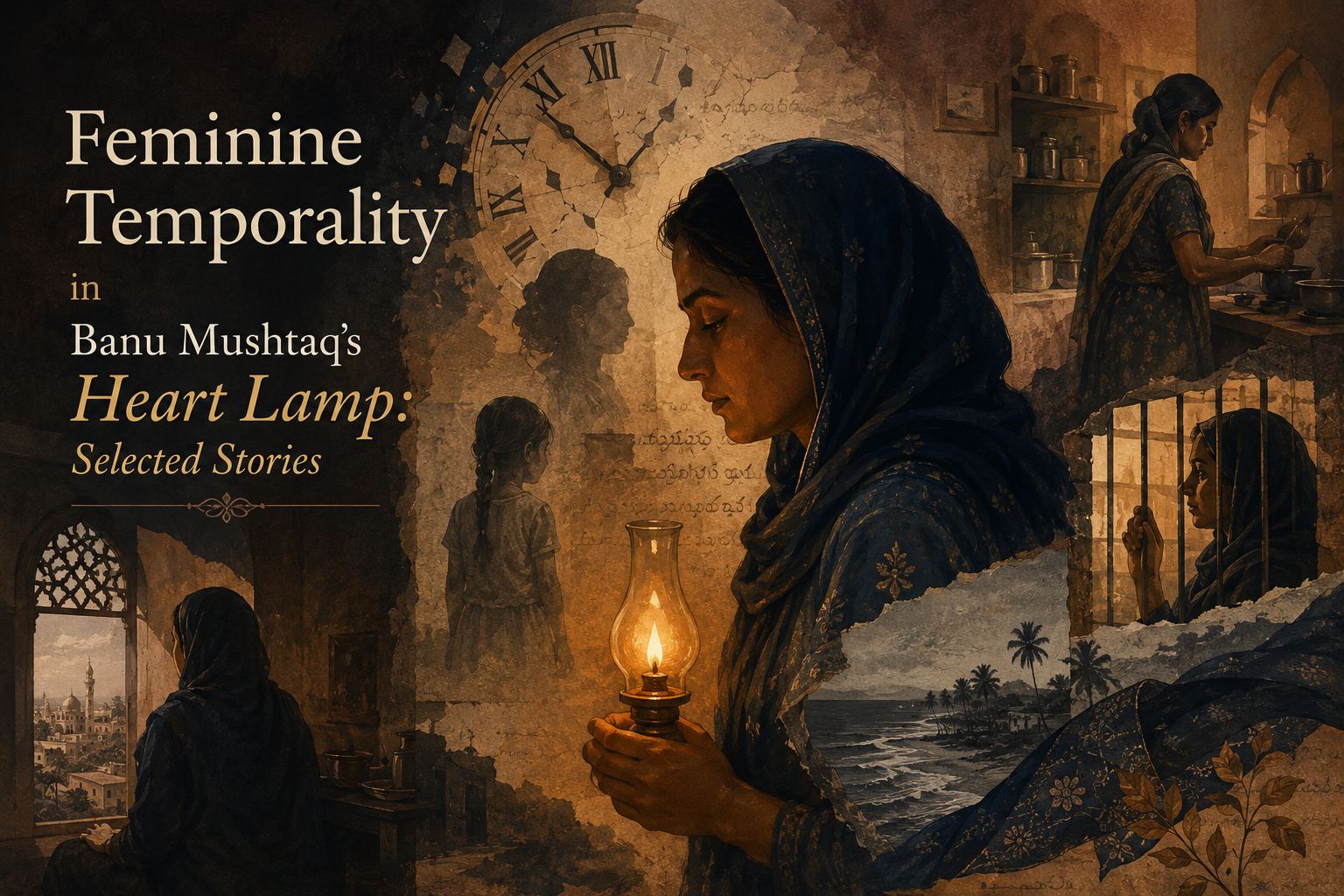
South Asian Muslim women's fiction remains relatively underrepresented in Anglophone literary scholarship, particularly writing produced in Indian regional languages. This article examines Banu Mushtaq’s Heart Lamp: Selected Stories (trans. Deepa Bhasthi, 2025) to analyze how feminine temporality is constructed and negotiated in South Asian Muslim women's everyday lives. Drawing on feminist temporality theory, particularly the work of Kristeva, Freeman, and Sharma, and feminist narratology, the study conducts close readings of selected stories from the collection. The analysis identifies four recurring temporal modes: waiting, bodily time, domestic repetition, and counter-temporal rupture, and examines how these are structured through narrative form. The article argues that Mushtaq's fiction constitutes a counter-temporal literary project that resists the linear time of patriarchal and national modernity by centering embodied, cyclical, and constrained temporalities. The study contributes to feminist literary scholarship on South Asian Muslim women's writing and demonstrates the relevance of feminist temporality frameworks for reading Kannada regional fiction.
References
- B. Mushtaq, Heart Lamp: Selected Stories, D. Bhasthi, Trans. And Other Stories, 2025.
- J. Kristeva, “Women’s time,” A. Jardine and H. Blake, Trans., Signs: Journal of Women in Culture and Society, vol. 7, no. 1, pp. 13–35, 1981, doi: https://doi.org/10.1086/493855.
- E. Freeman, Time Binds: Queer Temporalities, Queer Histories. Durham, NC, USA: Duke University Press, 2010, doi: https://doi.org/10.1215/9780822393184.
- S. Sharma, In the Meantime: Temporality and Cultural Politics. Durham, NC, USA: Duke University Press, 2014.
- R. Braidotti, Nomadic Theory: The Portable Rosi Braidotti. New York, NY, USA: Columbia University Press, 2011.
- J. Wajcman, Pressed for Time: The Acceleration of Life in Digital Capitalism. Chicago, IL, USA: University of Chicago Press, 2015.
- H. Lefebvre, Rhythmanalysis: Space, Time and Everyday Life, S. Elden and G. Moore, Trans. London, U.K.: Continuum, 2004, doi: https://doi.org/10.5040/9781472547385.
- M. W. Wright, Disposable Women and Other Myths of Global Capitalism. New York, NY, USA: Routledge, 2006.
- L. Abu-Lughod, Do Muslim Women Need Saving? Cambridge, MA, USA: Harvard University Press, 2013.
- S. Mahmood, Politics of Piety: The Islamic Revival and the Feminist Subject. Princeton, NJ, USA: Princeton University Press, 2005.
- M. R. Sabir, A. Irshad, M. J. Khan, and M. H. Nawaz, “Gendered spirits: Reclaiming militarism and feminine agency in Aboulela’s River Spirit,” in Proc. World Conference on Future Innovations and Sustainable Solutions. Futurity Research Publishing, 2024, doi: https://doi.org/10.5281/zenodo.14251694.
- M. R. Sabir, M. Asim, M. J. Khan, and M. H. Nawaz, “Exploring echoes of empowerment and androcentrism: A feminist study of Awais Khan’s ‘In the company of strangers,’” International Journal of Literature and Languages, vol. 4, no. 9, pp. 12–19, 2024, doi: https://doi.org/10.37547/ijll/Volume04Issue09-03.
- P. Chatterjee, The Nation and Its Fragments: Colonial and Postcolonial Histories. Princeton, NJ, USA: Princeton University Press, 1993.
- K. Sangari and S. Vaid, Eds., Recasting Women: Essays in Indian Colonial History. New Brunswick, NJ, USA: Rutgers University Press, 1990.
- A. Loomba, Colonialism/Postcolonialism, 3rd ed. London, U.K.: Routledge, 2015, doi: https://doi.org/10.4324/9781315751245.
- F. Afzal-Khan, Cultural Imperialism and the Indo-English Novel. University Park, PA, USA: Pennsylvania State University Press, 1993, doi: https://doi.org/10.5325/j.ctv14gphgb.
- R. Ahmed, Writing British Muslims: Education, Literature and National Identity. Manchester, U.K.: Manchester University Press, 2015. Available: https://manchesteruniversitypress.co.uk/9780719087400
- D. Candraningrum, T. Setyabudi, F. D. Wulandari, Y. Prastiwi, M. Daouda, and M. R. Sabir, “Digitizing dissent in fiction: Intan Paramaditha’s gendered narratives and planetary health,” in Proc. Int. Seminar of Languages, Arts and Literature Education (ISLALE 2025), pp. 157–178. Atlantis Press, 2025, doi: https://doi.org/10.2991/978-2-38476-501-0_17.
- G. Genette, Narrative Discourse: An Essay in Method. Ithaca, NY, USA: Cornell University Press, 1980.
- S. S. Lanser, Fictions of Authority: Women Writers and Narrative Voice. Ithaca, NY, USA: Cornell University Press, 1992.
- R. R. Warhol and D. P. Herndl, Eds., Feminisms: An Anthology of Literary Theory and Criticism, 2nd ed. New Brunswick, NJ, USA: Rutgers University Press, 1997.
- C. E. May, Ed., The New Short Story Theories. Athens, OH, USA: Ohio University Press, 1994.
- C. Hanson, Ed., Re-Reading the Short Story. Basingstoke, U.K.: Palgrave Macmillan, 1989.
- The Booker Prize Foundation, “Everything you need to know about Heart Lamp, winner of the International Booker Prize 2025,” The Booker Prizes, May 20, 2025. Accessed: Mar. 28, 2026. [Online]. Available: https://thebookerprizes.com/the-booker-library/features/everything-to-know-heart-lamp-winner-international-booker-prize-2025
- K. Sivaranjani and P. Rajeswari, “Exploring gender, identity, and resistance in Banu Mushtaq’s Heart Lamp: Selected Stories,” International Journal of All Research Education and Scientific Methods, vol. 13, no. 5, 2025. Available: https://www.ijaresm.com/exploring-gender-identity-and-resistance-in-banu-mushtaq-s-heart-lamp-selected-stories
- A. Sattar, “Silenced by tradition, resurrected by resistance: Projection of subaltern woman in Banu Mushtaq’s story Heart Lamp,” ShodhGyan-NU: Journal of Literature and Culture Studies, vol. 3, no. 2, pp. 96–102, 2025, doi: https://doi.org/10.29121/shodhgyan.v3.i2.2025.63.
- R. S. Solanke, “Illuminating the inner world: Metaphorical interpretations of Banu Mushtaq’s Heart Lamp,” The Rubrics, vol. 7, no. 8, pp. 1–6, 2025, doi: https://doi.org/10.5281/zenodo.17538535.
- Z. Chowdhary, “Heart Lamp: Selected Stories (review),” Wasafiri, vol. 40, no. 3, pp. 130–132, 2025, doi: https://doi.org/10.1080/02690055.2025.2498212.