
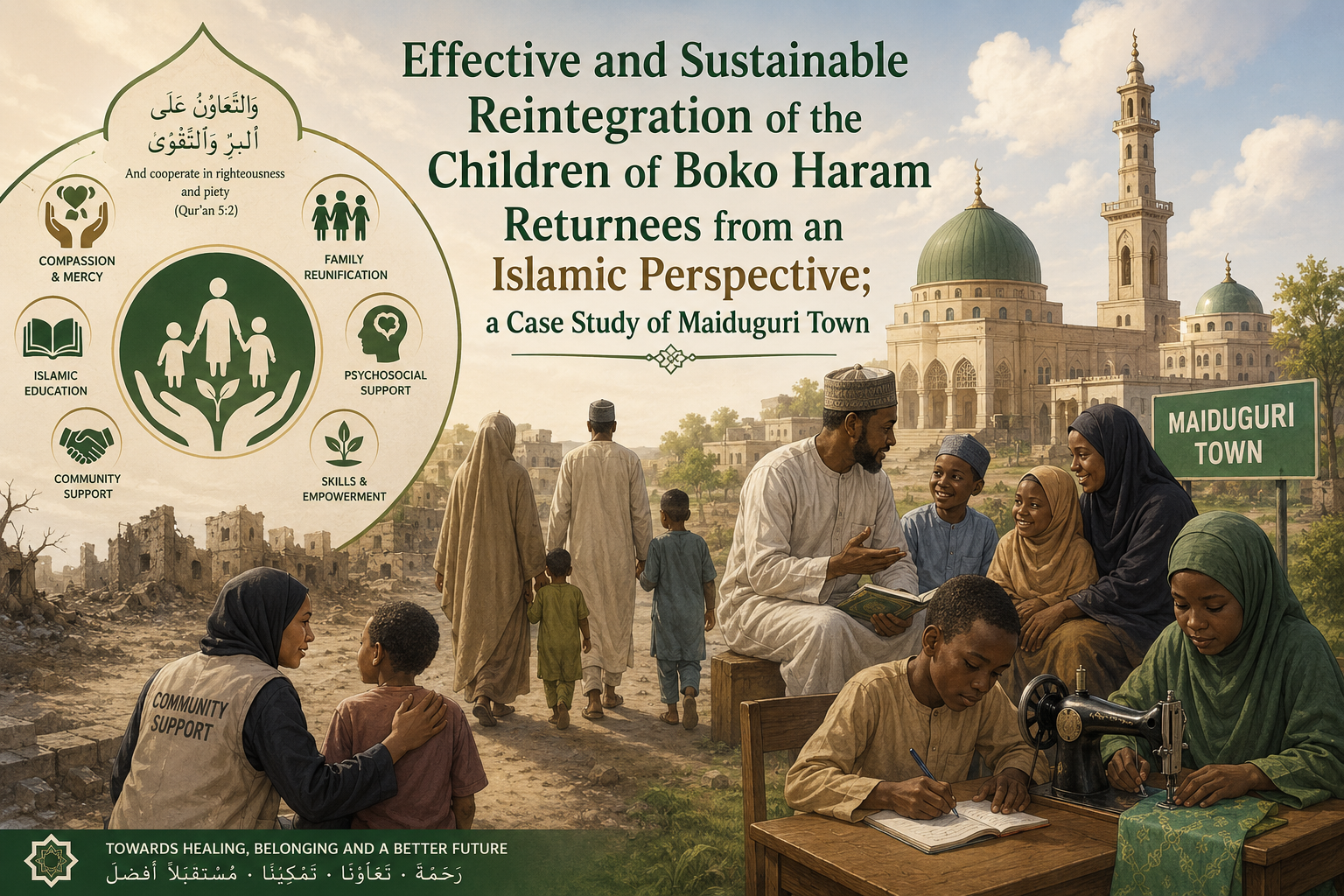
Effective and Sustainable Reintegration of the Children of Boko Haram Returnees from an Islamic Perspective; a Case Study of Maiduguri Town
Published 2026-05-23
Keywords
- Reintegration,
- Boko Haram Returnees,
- Children,
- Conflict,
- Islamic Perspective
- Psychosocial Support ...More
Copyright (c) 2026 Ibrahim Abubakar Mustapha, Muhammad A Ajiri, Ibrahim Lawan Mustapha, Yagana Goma, Abba Kale (Author)

This work is licensed under a Creative Commons Attribution 4.0 International License.
Abstract
Purpose – This study examines the effective and sustainable reintegration of children of Boko Haram returnees from an Islamic perspective in Northeast Nigeria. The research addresses the persistent social stigma, fear, discrimination, and mistrust faced by these children in post-conflict communities. It argues that reintegration should not only focus on security and humanitarian dimensions but also incorporate Islamic ethical values to foster reconciliation, peace-building, and long-term community healing. Design/methods/approach – The study employed a qualitative research design using Focus Group Discussions (FGDs) with community members and Key Informant Interviews (KIIs) involving Islamic scholars (Ulama), traditional rulers, camp managers, and humanitarian actors. In addition, document analysis was conducted on Qur’anic verses, Hadith, and Islamic literature concerning forgiveness, justice, rehabilitation, and child protection. The collected data were analyzed thematically to identify major barriers to reintegration and the role of Islamic teachings in promoting social cohesion. Findings – The study found that children of Boko Haram returnees are largely perceived as victims of conflict rather than perpetrators of violence. However, stigma, social isolation, fear, and discrimination remain major obstacles to successful reintegration. Sustainable reintegration requires community sensitization, psychosocial support, access to education and vocational empowerment, and the active involvement of religious and traditional institutions. Islamic values such as rahmah (compassion), tawbah (repentance), ‘adl (justice), and collective responsibility significantly contribute to social healing and reconciliation. Research implications/limitations – The study is limited to selected communities in Northeast Nigeria and relies mainly on qualitative data, which may limit broader generalization. Nevertheless, the findings provide important insights for policymakers, humanitarian agencies, and religious leaders in designing culturally and religiously sensitive reintegration programs. Originality/value – This study offers a faith-based reintegration framework that integrates Islamic teachings with modern reintegration theories. It highlights the underutilized role of mosques, Sangaya and Islamiya schools, zakat institutions, and Ulama in supporting sustainable reintegration and preventing future radicalization.
References
- Committee on the Elimination of Discrimination against Women (CEDAW), Nigeria: UN Committee Finds Grave Systemic Violations Persist after Chibok Mass Abduction of Schoolgirls, United Nations, 2025, 97-106.
- Office of the High Commissioner for Human Rights (OHCHR), UN Human Rights Appeals, 2026, 39-44.
- UNICEF, Economic Reintegration Programme for Children of Boko Haram Survivors: Progress Report. United Nations Children's Fund Nigeria, 2024, 46-48.
- O. Adebimpe, S. Musa, & H. Bappah, Beyond Captivity: The Challenges of Reintegrating Boko Haram Returnees in Northeast Nigeria. Journal of Peacebuilding & Development, 18(3), 2023, 312-328.
- O. Adebimpe, S. Musa, & H. Bappah, Beyond Captivity: The Challenges of Reintegrating Boko Haram Returnees in Northeast Nigeria. Journal of Peacebuilding & Development, 18(3), 2023, 312-328.
- UNICEF, Statelessness and Stigma: The 400,000 Children of Boko Haram. United Nations Children's Fund, 2024, 98-99.
- UNICEF, Economic Impact of Insurgency in Northeast Nigeria: A Decade of Lost Opportunities. United Nations Children's Fund, 2024, 44-47.
- NEEM Foundation, Trauma-Informed Accelerated Education: Annual Impact Report 2023. NEEM Foundation, 2023, 66-67.
- International Alert, Trauma-Responsive Education in Borno State: The Lafiya Sarari Model, International Alert Nigeria, 2024, 92.
- International Alert, Trauma-Responsive Education in Borno State: The Lafiya Sarari Model, International Alert Nigeria, 2024, 94.
- Alliance for Child Protection in Humanitarian Action, (ACPHA), Accelerated Education and child Protection in Northeast Nigeria: Learning from the AENN Programme 2018-2021. Alliance for Child Protection in Humanitarian Action, 2025, 43.
- Mercy Corps, Community-led Reintegration in Northeast Nigeria: Evaluating the Borno Model. Mercy Corps, 2024, 9.
- T. Akintayo, The Borno Model: Vernacular Security or Vernacular Anxiety? Examining Community Perceptions of Ex-fighter Reintegration in Northeast Nigeria. Conflict, Security & Development, 25(1), 2025, 78-95. https://doi.org/10.1080/10.1017/eis.2025.10024
- E. Okafor, & M. Ibrahim, Rebuilding Homes and Relationships: Community Co-design and Sulhu (Reconciliation) in Gwoza. Peacebuilding, 12(3), 2024, 289-306.
- Y. Al-Qaradawi, Repentance in Islam: Theology, ethics and practice. International Institute of Islamic Thought, 2021, 66-97.
- A. Abubakar, & M. Yusuf, Istijarah: Indigenous Islamic Frameworks for Humanitarian Protection in Northern Nigeria. Journal of Islamic Studies and Culture, 10(2), 2022, 45-62.
- E. Okafor, & M. Ibrahim, Rebuilding Homes and Relationships: Community Co-design and Sulhu (Reconciliation) in Gwoza. Peacebuilding, 12(3), 2024, 289-306.
- T. Akintayo, Sulhu as Local Peacebuilding: Religious Mediation and Reconciliation in Post-Insurgency Northern Nigeria. Journal of Religion in Africa, 55(2), 2025, 156-178. https://doi.org/10.1080/21647259.2025.2450574
- S. Musa, & H. Bappah, Stigma, Exclusion and the Challenges of Reintegrating Boko Haram Returnees in Borno State. African Security Review, 32(4), 2023, 378-395.
- F. Chidozie, Religious Attachment and Resilience among Boko Haram Survivors: Pathways to Recovery in Northeast Nigeria. Journal of Traumatic Stress, 38(1), 2025, 89-104.
- A. Abubakar, & M. Yusuf, Istijarah: Indigenous Islamic Frameworks for Humanitarian Protection in Northern Nigeria. Journal of Islamic Studies and Culture, 10(2), 2022, 45-62.
- M. Abdullahi, & H. Onapajo, Community engagement and reintegration programs in conflict zones. Journal of Peace and Development Studies, 18(1), 2024, 55–72. https://doi.org/10./jpds.2024.01801
- S. Musa, & H. Bappah, Stigma, Exclusion and the Challenges of Reintegrating Boko Haram Returnees in Borno State. African Security Review, 32(4), 2023, 378-395.
- O. Adebimpe, S. Musa, & H. Bappah, Beyond Captivity: The Challenges of Reintegrating Boko Haram Returnees in Northeast Nigeria. Journal of Peacebuilding & Development, 18(3), 2023, 312-328.
- O. Adebimpe, S. Musa, & H. Bappah, Beyond Captivity: The Challenges of Reintegrating Boko Haram Returnees in Northeast Nigeria. Journal of Peacebuilding & Development, 18(3), 2023, 312-328.
- Office of the High Commissioner for Human Rights (OHCHR). UN Human Rights Appeal, 2026, 57-63.
- T. Akintayo, Sulhu as Local Peacebuilding: Religious Mediation and Reconciliation in Post-Insurgency Northern Nigeria. Journal of Religion in Africa, 55(2), 2025, 156-178. https://doi.org/10.1080/21647259.2025.2450574
- A. Abubakar, & M. Yusuf, Istijarah: Indigenous Islamic Frameworks for Humanitarian Protection in Northern Nigeria. Journal of Islamic Studies and Culture, 10(2), 2022, 45-62.
- D. Agbiboa, The Challenges of Reintegrating Ex-Combatants in Nigeria: The Case of Boko Haram. Conflict, Security & Development, 15(4), 2015, 345–368.
- A. Mohammadi, M. J. Abbasi-Shavazi, & R. Sadeghi, Return to Home: Reintegration and Sustainability of Return to Post-Conflict Contexts. In Hugo G., Abbasi Shavazi M., & Kraly E. (Eds.), Demography of Refugee and Forced Migration 2018, 251-270. Springer: Berlin. https://doi.org/10.1007/978-3-319-67147-5_13.
- G. Brownell, & R. Basham, NGO Strategy toward the Reintegration of Child Soldiers in Liberia, Africa: An Online Survey of Services, Roles, and Activities. International Social Work, 60(5), 2017, 1074-1086. https://doi.org/10.1177/0020872817704278
- Y. Al-Qaradawi, Repentance in Islam: Theology, ethics and practice. International Institute of Islamic Thought, 2021, 69-102.