
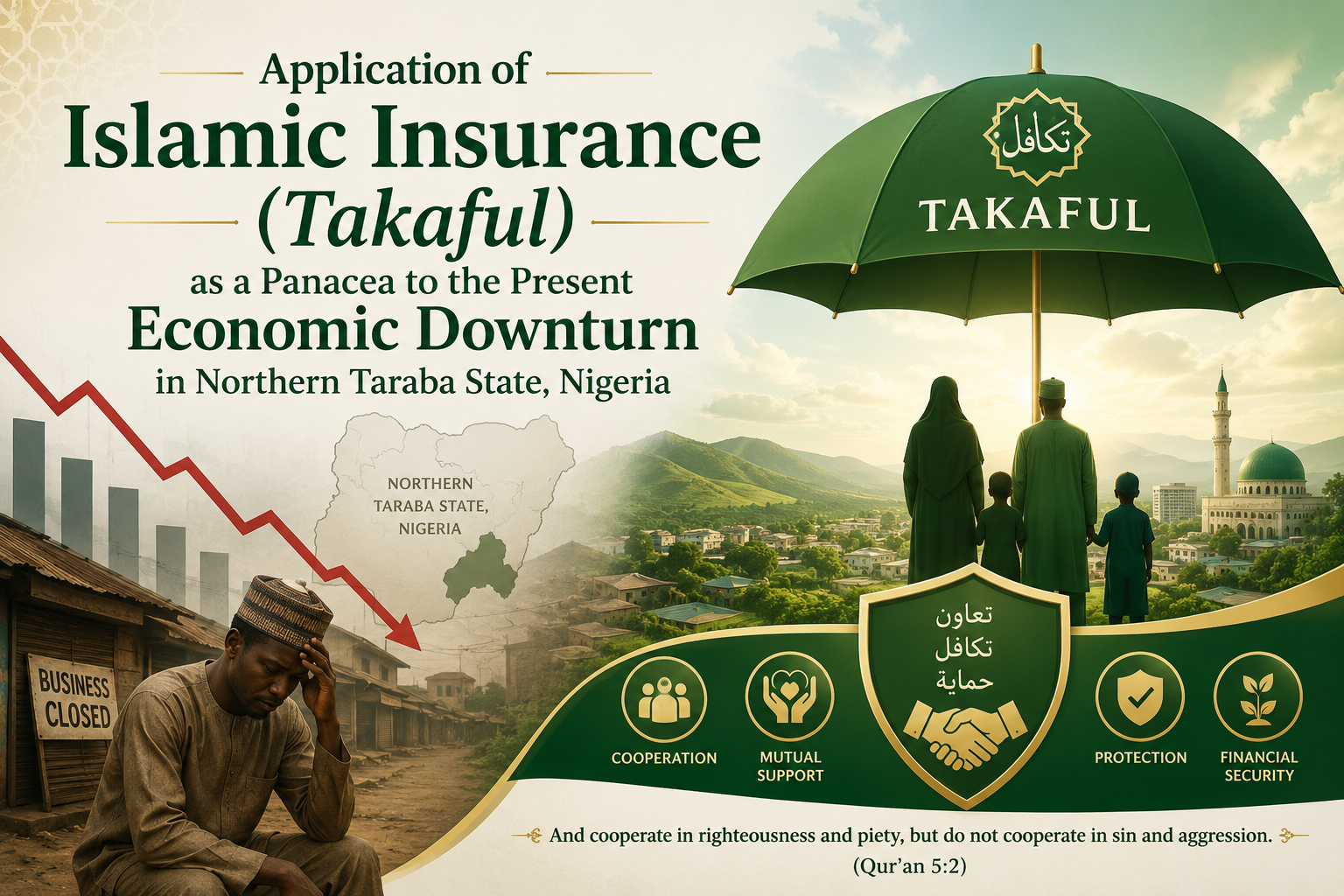
Application of Islamic Insurance (Takaful) as a panacea to the present Economic Downturn in Northern Taraba State, Nigeria
Published 2026-06-18
Keywords
- Islamic Insurance,
- Takaful,
- Economic Downturn,
- Risk Mitigation,
- Business Continuity
- Shari'ah Compliance,
- Financial Inclusion,
- Northen Taraba State ...More
Copyright (c) 2026 Haruna Dahiru, Lawan Abdullahi Muhammad , Steve Paul Anuye , Lawan Garba (Author)

This work is licensed under a Creative Commons Attribution 4.0 International License.
Abstract
Purpose – This study examines the application of Islamic insurance (Takaful) as a strategic mechanism for addressing the ongoing economic downturn in Northern Taraba State, Nigeria. The research explores the potential of Takaful to enhance economic resilience, promote financial inclusion, and support sustainable socio-economic development in a region characterized by agricultural vulnerability, insecurity, limited access to formal financial services, and unstable household incomes. Design/methodology/approach – The study adopts a mixed-methods approach, integrating quantitative and qualitative analyses. Data were examined to assess the role of Takaful contributions (tabarru’) in risk mitigation, livelihood protection, and business continuity among households and small and medium enterprises (SMEs). The analysis is further grounded in Islamic normative sources, including relevant Qur’anic injunctions and Prophetic traditions that emphasize mutual cooperation, solidarity, and ethical risk-sharing. Findings – The findings indicate that Takaful provides an effective alternative to conventional insurance by promoting collective responsibility, reducing financial vulnerability, and strengthening risk management mechanisms. Empirical evidence suggests that Takaful contributes to greater financial inclusion among Muslim communities, enhances economic empowerment, and supports the sustainability of household and business activities during periods of economic uncertainty. The principles of mutual assistance (ta‘āwun) and ethical financial participation emerge as key factors in fostering community resilience. Research implications/limitations – The study focuses on Northern Taraba State and may not fully capture the diverse socio-economic conditions of other regions. Future research may undertake comparative studies across different states or examine long-term impacts of Takaful adoption on poverty reduction and economic growth. Originality/value – This study contributes to the growing literature on Islamic finance by demonstrating the practical relevance of Takaful as a Shari’ah-compliant instrument for economic stabilization. It highlights the role of Islamic insurance in promoting equitable development, social protection, and financial sustainability within vulnerable communities.
References
- S. S. Al Hallaq, “Islamic Insurance in Practice: Modes, Sizes and Structure in Selected Markets”, in Ahmed, A. Y. ed., Principles of Takaful, 2012, 113-150. Manama: BIBF.
- A. Ya’u, “Prospecting for Sustainable Micro-Takaful Business in Nigeria, 2010. http://ssrn.com/abstract=1997441
- D. M. Atiyaye, et al, “The Impact of Communal Clashes on Economic Development of Takum Local Government Area, Taraba State.” Kashere Journal of Politics and International Relations, Vol. 3, No. 4, 2025.
- D. F. Tukura, and N. T. Tukura. “Subsidy Removal and Socio Economic Development in Wukari Local Government Area, Taraba State, Nigeria.” Multidisciplinary Journal of Management and Social Sciences, vVl. 2, No. 3, 2025.
- S. N. Sayedi, “Determinants of Intention to Adopt Auto Insurance (Takāful) Business Among Vehicle Owners in Nigeria.” Journal of King Abdulaziz University: Islamic Economics, Vol. 37, No. 1, 2024.
- A. A. Ardo, and B. Saiti. “Takaful Practice in Nigeria: History, Present and Futures.” European Journal of Islamic Finance, 2025.
- Ṣaḥīḥ al-Bukhārī. Translated by Muhammad Muhsin Khan, Dar-us-Salam, 1997. Hadith No. 6011.
- J. Arifin, A. S. Yazid, & Z. Sulong, A Conceptual Model of Literature Review for Family Takaful (Islamic Life Insurance) Demand in Malaysia. In International Business Research (Vol. 6, Issue 3). Canadian Center of Science and Education, 2013. https://doi.org/10.5539/ibr.v6n3p210
- F. H. Nazir, & A. B. M. Noor, An Assessment of Customer’s Preferences on The Selection of Takaful over Conventional: A Case of Saudi Arabia. In Tazkia Islamic Finance and Business Review, 12(1). Tazkia University College of Islamic Economics; Association of Islamic Economics, 2018.
- S. Fauzilah, D. I. Mohamed, H. R. Razman, and R. Norizan, Developing a Takaful property framework for small and medium enterprises. World Applied Sciences Journal 35 (8), 2017, 1602-1609.
- S. Zahariah, A. Hasni, A. R. Husniyah, B. Nur-Zahidah, P. Faridah, Determinants of takaful performance in Malaysia. Journal of Entrepreneurship, Business and Economics, 2022, 10 (2S2), 2022, 1–17.
- A. Bisan, M. Yazeed, K. Rasha, and S. David, The role of takaful insurance in achieving the competitive advantage of the Jordanian Islamic insurance company. Journal of Biomechanical Science and Engineering Japan Society of Mechanical Engineers, 2023. ISSN: 1880-9863
- A. M. Amirul, N.J. Mohamad, and F. S. A. Sharifah, Takaful operators’ corporate social performance (CSP): an industry perspective. SHS Web of Conferences 36, 2017, 00001.
- Investopedia. (2016). Takaful. Retrieved December 5, 2016, from Investopedia Web Site: http://www.investopedia.com/terms/t/takaful.asp
- K. L. Hussein, and A. Sharofiddin. “The Level of Acceptance and Awareness of Takaful in Nigeria.” Journal of Islamic Finance, 2025, 163-175.
- H. A. Ghani, & S. Lambak, Determinants of Takaful: Case in East Coast Region of Malaysia. International Journal of Academic Research in Business and Social Sciences, 8(12), 2018. https://doi.org/10.6007/ijarbss/v8-i12/5059
- A. H. Hafiz, Takaful models: origin, progression and future. Journal of Islamic Marketing, 2019, 1759-0833, DOI: https://doi.org/10.1108/JIMA-04-2018-0078
- H. A. Ghani, & S. Lambak, Determinants of Takaful: Case in East Coast Region of Malaysia. International Journal of Academic Research in Business and Social Sciences, 8(12), 2018. https://doi.org/10.6007/ijarbss/v8-i12/5059
- F. H. Nazir, & A. B. M. Noor, An Assessment of Customer’s Preferences on The Selection of Takaful over Conventional: A Case of Saudi Arabia. In Tazkia Islamic Finance and Business Review, 12(1). Tazkia University College of Islamic Economics; Association of Islamic Economics, 2018.
- N. A. Abdullah, Studies on Takaful Agent Behaviour against Consumers. International Journal of Academic Research in Business and Social Sciences, 8(11), 2018. https://doi.org/10.6007/ijarbss/v8-i11/4975
- Qur’an, Surah Al-Ma’idah 5:2.
- Qur’an, Surah Al-Hashr 59:9.
- Al-Imam Abu Zakariya Yahya bin Sharaf An-Nawawi, (1999). English Translation of Riyad Us-Salihin (The Garden of the Righteous), with Commentary by Hafiz Salahuddin Yisuf. Riyadh, DarUs-Salam Publications, Hadith No. 224.
- Sahih Muslim, Hadith No. 1547.
- M. Habibur Rahman, & N. S. Zakiyyah A critical study of tabarrù (donation)-based takaful models: determining tàawun (mutual assistance) as the underlying notion of takaful Available to Purchase. Journal of Islamic Accounting and Business Research, (2025) https://doi.org/10.1108/JIABR-12-2023-0457
- AAOIFI, Accounting and Auditing Organisation for Islamic Financial Institutions. Shari’ah Standards. Manama: Dar al-Maiman Publishing and Distributing, 2015.
- M. T. Usmani, An Introduction to Islamic Finance. Kluwer Law International, 2002, 69-78.
- Qur’an, Surah Al-Ma’idah 5:2.
- M. M. Billah, Applied Takaful and Modern Insurance. Sweet & Maxwell Asia, 2007, 45-57.
- H. M. Hasim, Developing a Conceptual Framework of Microtakaful as a Strategy towards Poverty Alleviation. Journal of Accounting and Taxation Vol. 3(5), 2011, 79-90.
- M. A. Ismail, Keperluan Menghayati Konsep Takaful. Institut Kefahman Islam Malaysia, 2012.
- Qur’an, Surah Al-Baqarah 2:275.
- M. Ayub, Understanding Islamic finance. John Wiley & Sons, 2007.
- M. Obaidullah, Islamic Financial Services. Islamic Economics Research Center, King Abdulaziz University, 2005.
- M. M. Billah, Islamic insurance: Theory and Practice. Islamic Banking and Finance Institute Malaysia, 2003.
- Z. Iqbal, & A. Mirakhor, An Introduction to Islamic Finance: Theory and Practice, 2011.
- M. Ayub, Understanding Islamic finance. John Wiley & Sons, 2007.
- M. Ayub, Understanding Islamic finance. John Wiley & Sons, 2007.
- Z. Iqbal, & A. Mirakhor, An Introduction to Islamic Finance: Theory and Practice, 2011.
- E. D. Oruonye et al., “Assessment of Rural Livelihood Strategies in Taraba State, Nigeria.” Jalingo Journal of Social and Management Sciences, Vol. 5, No. 4, 2024, 79-92.
- B. Adamu, & S. Bakari, Economic Livelihood and Rural Development in Taraba State. Jalingo University Press, 2024.
- Z. Iqbal, & A. Mirakhor, An Introduction to Islamic Finance: Theory and Practice, 2011.
- M. M. Billah, Islamic insurance: Theory and Practice. Islamic Banking and Finance Institute Malaysia, 2003.
- M. Ayub, Understanding Islamic finance. John Wiley & Sons, 2007.
- M. Obaidullah, Islamic Financial Services. Islamic Economics Research Center, King Abdulaziz University, 2005.
- Z. Iqbal, & A. Mirakhor, An Introduction to Islamic Finance: Theory and Practice, 2011.