
Published 2026-02-20
Keywords
- Speculative Business,
- Riba,
- Gharar,
- Maysir,
- Shariah-compliant Business
- Risk,
- Benefits ...More
Copyright (c) 2026 Abba Alhaji Bukar, Wakil Mala Bukar, Bintu Mustapha (Author)

This work is licensed under a Creative Commons Attribution 4.0 International License.
Abstract
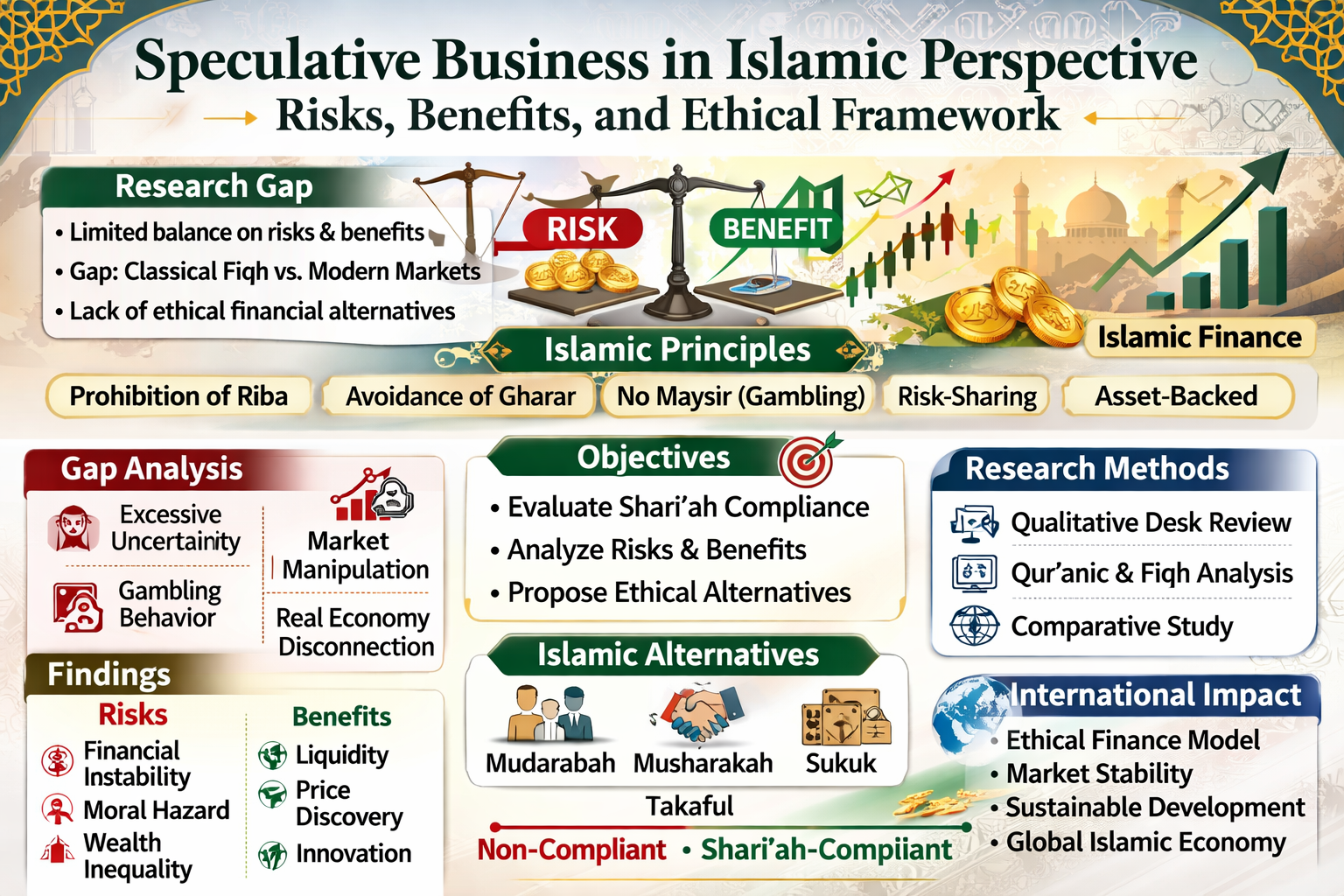
This study addresses a critical gap in contemporary Islamic finance literature concerning the normative and empirical assessment of speculative business practices. While prior research predominantly adopts a prohibitive approach by equating speculation with riba, gharar, and maysir, limited attention has been given to a balanced evaluation that systematically examines both the risks and the conditional benefits of speculative activities within a Shari’ah-compliant framework. Moreover, insufficient integration exists between classical fiqh al-muʿāmalāt principles and modern speculative instruments such as derivatives, foreign exchange trading, and cryptocurrencies. The objective of this research is to critically analyze speculative business from an Islamic perspective by assessing its compatibility with the objectives of Shari’ah (maqāṣid al-sharī‘ah), particularly the protection of wealth (ḥifẓ al-māl), and by identifying its socio-economic implications. Methodologically, the study employs a qualitative survey design based on systematic desk review, synthesizing classical jurisprudential sources, Qur’anic and Hadith foundations, and contemporary empirical financial studies. Analytical triangulation is applied to examine risk origin, ethical boundaries, and practical financial structures. The findings reveal that speculative business becomes impermissible when characterized by excessive uncertainty, gambling-like behavior, and detachment from real economic activity. However, rational risk-taking linked to tangible assets, transparent contracts, and equitable profit-and-loss sharing may yield legitimate economic benefits such as market liquidity, price discovery, innovation, and capital allocation. The study further proposes Shari’ah-compliant alternatives, including mudarabah, musharakah, and asset-backed investment mechanisms, as viable substitutes for high-risk speculative models. Internationally, the research contributes to the development of ethical financial governance frameworks, offering policy-relevant insights for emerging and developed economies seeking to enhance market stability, social justice, and sustainable economic growth within Islamic and global financial systems.
References
- H. Atta, An Examination of the Effect of Islamic Ethical Screens on Financial Performance and of Conditioning Information on Performance Measures, Dissertation Department of Economics and Finance at University of Durham, 2000.
- W. J. Baumol, Speculation, Profitability, and Stability. The Review of Economics and Statistics, 1957, 263-271.
- M. Friedman, In Defense of Destabilizing Speculation. Essays in Economics and Econometrics, 1960, 133-141.
- Z. Ahmad, Speculative Business Transactions and Islamic Finance: A Transaction Based to a Principle Based Approach. In Handbook on Islam and Economic Life, Edward Elgar Publishing, 2015, 332-353.
- S. Al-Suwailem, Speculation in Islamic Finance: Conventional Perspective and the Islamic Alternative. Journal of Islamic Accounting and Business Research, (4), 2018, 490-504.
- K. Amir, Speculative Activities, Efficiency and Normative Stock Exchange, J.KAU: Islamic Economic, Vol. 13, 2001, 31 50.
- K. Amir, “Islam and the Stock Market: Evidence from the United States”, Work paper Woodbury School of Business, 2012, 1-37.
- I. Muhammad, Dasar-dasar Keuangan Islam, Yogyakarta: Ekonisia, 2004.
- M. Iqbal, Asurasi Umum Shariah dalam Praktik, Upaya Menghilangkan Ġarar,Maysir dan Riba, Jakarta: Gema Insani, 2006, 26.
- A. V. Velden, and O. V. Buul, Really Investing for the Long-Term: A Case Study, in Rotman International Journal of Pension Management, Vol. 5, Issue 1, Spring, 2012, 50-57.
- Forbes. The Risks and Rewards of Speculative Investing. 2021. https://www.forbes.com/speculative-investing-risk-reward
- M. A. Jaradat, An Empirical Investigation of Rational Speculative Bubbles in the Jordanian Stock Market: A Nonparametric Approach, International Management Review, Vol. 5, 2009, 92-98.
- S. H. Mokhtar, Detecting Rational Spekulative Buble in the Malaysian Stock Market, Journal of Financial and Economic, Issue 6, 2006, 102-115.
- F. Kamari, S. Farhad and M. Mohammad, Studying the Relation of Indices and Duration Dependence Test in Tehran Stock Exchange, International Research Journal of Applied and Basic Sciences, Vol. 4, 2013, 2494-2500.
- T. Engsted, and B. Nielsen, Testing for Rational Bubbles in a Co-Explosive Vector Autoregression, The Econometrics Journal, 2012, 154-162.
- V. Sunderarajan, 2007, “Risk Characteristics of Islamic Products Implications for Risk Measurement and Supervision,” in Simon, A and R A. Abdel Karim. (eds), Islamic Finance: The Regulatory Challenge, Singapore: Wiley, 2007.
- M.U. Draz, F. Ahmad, S. Ali, The Prevailing Skepticism about Islamic Banking and the Re-assessment of Interest-Free Financial Products: An Explanatory Study, Kuala Lumpur/Lanzhou/Lahore, 28 November 2011.
- M.U. Draz, F. Ahmad, S. Ali, The Prevailing Skepticism about Islamic Banking and the Re-assessment of Interest-Free Financial Products: An Explanatory Study, Kuala Lumpur/Lanzhou/Lahore, 28 November 2011.
- A. Ernst, Promoting Islamic Finance and Islamic Banking – A legal analysis of the potential for Islamic Banking products in Germany, Institut für Rechtspolitik an der Universität Trier, 2011.
- M. Saeed, Z. U. Ahmed, and S. M. Mukhtar, "International Marketing Ethics from an Islamic Perspective: A Value-Maximization Approach." Journal of Business Ethics, 32(2), 2001, 127–142.
- N. Kamel, Intrinsic Bubbles in the American Stock Exchange: The Case of S&P 500 Index, International Journal of Economics and Finance, Vol. 3, No. 1, 2011, 124-132.
- T. Engsted, and C. Tanggaard, Speculative Bubbles in Stock Prices. Test Based on the Price-Dividend Ratio, Working Paper Arhus School of Business, Lund University, 2004.
- M.T. Al-Hilali, and M.M. Khan, Translation of the Meanings of the Noble Qur’an in the English Language. Madinah, K.S.A: King Fard Complex for the Printing of the Holy Qur’an, 2002. Qur’an, Surah Al-Baqarah Verse 275.
- Al-Hilali, M.T., and Khan, M.M., (2002). Translation of the Meanings of the Noble Qur’an in the English Language. Madinah, K.S.A: King Fard Complex for the Printing of the Holy Qur’an, Surah Al-Baqarah Verse 42.
- Al-Hilali, M.T., and Khan, M.M., (2002). Translation of the Meanings of the Noble Qur’an in the English Language. Madinah, K.S.A: King Fard Complex for the Printing of the Holy Qur’an, Surah Mutaffifin Verses 1-3.
- Al-Hilali, M.T., and Khan, M.M., (2002). Translation of the Meanings of the Noble Qur’an in the English Language. Madinah, K.S.A: King Fard Complex for the Printing of the Holy Qur’an, Surah Al-Isra Verse 35.
- M.T. Al-Hilali, and M.M. Khan, Translation of the Meanings of the Noble Qur’an in the English Language. Madinah, K.S.A: King Fard Complex for the Printing of the Holy Qur’an, 2002. Qur’an, Surah Al-Baqarah Verse 276.
- M.T. Al-Hilali, and M.M. Khan, Translation of the Meanings of the Noble Qur’an in the English Language. Madinah, K.S.A: King Fard Complex for the Printing of the Holy Qur’an, 2002. Qur’an, Surah Al-Nisa Verse 29.
- Sunan al-Tirmidhi Book 12, Hadith 1211.
- Sahih Muslim Book 10, Hadith 3683.
- Al-Mu’jam & Al-Bayhaqi.
- Sunan al-Tirmidhi Hadith Number 1209.
- P. B. Thompson, The Philosophical Foundations of Risk. Southern Journal of Philosophy, 24, 1986, 273-286. doi: https://doi.org/10.1111/j.2041-6962.1986.tb01566.x
- C. E. Althaus, A Disciplinary Perspective on the Epistemo Logical Status of Risk. Risk Analysis, 25, 2005, 567-588. doi: https://doi.org/10.1111/j.1539-6924.2005.00625.x
- R. M. Trimpop, The Psychology of Risk Taking Behaviour. Amsterdam, The Netherlands: North-Holland, 1994.
- R. M. Trimpop, The Psychology of Risk Taking Behaviour. Amsterdam, The Netherlands: North-Holland, 1994.
- T. Khan, & H. Ahmed, Risk Management: An Analysis of Issues in Islamic Financial Industry (Occasional Paper No. 5). Jeddah, Saudi Arabia: Islamic Research and Training Institute, 2001.
- A. A. Tariq, Managing Financial Risks of Sukuk Structures (Doctoral thesis). Loughborough University, UK, 2004. Retrieved from http://kantakji.com/media/7829/f216.pdf
- S. Al-Suwailem, Risk in a Turbulent World: Insights from Islamic Finance. In S. Archer & R. A. A. Karim (Eds.), Islamic Finance: The New Regulatory Challenge (pp. 77-94). Singapore: John Wiley, 2013.
- M.T. Al-Hilali, and M.M. Khan, Translation of the Meanings of the Noble Qur’an in the English Language. Madinah, K.S.A: King Fard Complex for the Printing of the Holy Qur’an, 2002. Qur’an Surah Al-Baqarah Verse 195.
- M. Y. Hidrus, & A. Abd Rahman, Pengamalan Pengurusan Risiko Kredit Serta Hubungan Terhadap Kesan Kecekapan di Insti Tusi Perbankan dan Dewangan Malaysia. Prosiding PERKEM VIII, 3, 2013, 1375-1400.
- M. A. Laldin, Shari’ah Non-Compliance Risk. In S. Archer & R. A. A. Karim (Eds.), Islamic finance: The new regulatory challenge (2nd ed.) Singapore: John Wiley, 2013237-260.
- M.T. Al-Hilali, and M.M. Khan, Translation of the Meanings of the Noble Qur’an in the English Language. Madinah, K.S.A: King Fard Complex for the Printing of the Holy Qur’an, 2002. Qur’an Surah Yusuf, 12:67.
- V. Sundararajan, & L. Errico, Islamic Financial Institution and Products in the Global Financial System: Key Issues in Risk Management and Challenges Ahead (International Monetary Fund working paper). Washington, DC: International Monetary Fund, 2002.
- F. Khan, Islamic Perspectives on Speculative Business Practices and Their Alternatives. Journal of Islamic Economics and Finance, 1(1), 2014, 25-39.
- A. Chargi, Origin and Development of Commercial and Islamic Banking Operations, Islamic Economics Volume 18, No. 2, 2005.
- A. Chargi, Origin and Development of Commercial and Islamic Banking Operations, Islamic Economics Volume 18, No. 2, 2005.
- Laajimi, A., & Tair, S. N. (2017). Speculative Transactions and Islamic Finance: A Critical Analysis. Journal of Islamic Law Studies, 23(1), 89-105.
- S. Mahdavi, Islamic Perspectives on Futures Trading and Speculation. Journal of Financial Regulation and Compliance, 20(3), 2012, 276-291.
- Azimi, S. (2016). Traditional and Contemporary Views on Speculation in Islamic Finance. Middle East Journal of Business, 11(2), 42-60.
- M. N. Siddiqi, Speculation in financial markets: An Islamic view. ISRA International Journal of Islamic Finance, 1(1), 2009, 73-84.
- S. Al-Suwailem, Speculation in Islamic Finance: Conventional Perspective and the Islamic Alternative. Journal of Islamic Accounting and Business Research, (4), 2018, 490-504.
- A. Rahnema, Speculative Business Practices and the Need for Ethical Reform in Islamic Finance. Journal of Business Ethics, 104 (2), 2011, 287-298.
- M. Matwally, The Prohibition of Speculative Business Transactions in Islamic Finance. Journal of Islamic Economics, Banking, and Finance, 9(2), 2013, 23-38.
- M. A. El-Gamal, Islamic Finance: Law, Economics, and Practice. Cambridge University Press, 2006.
- Kamali, M. H. (2009). Islamic commercial law: An analysis of futures and speculation. Islamic Law and Society, 16(3), 308-332.
- I. Akkizidis, & S. K. Khandelwal, Financial Risk Management for Islamic Banking and Finance. New York, NY: Palgrave Macmillan, 2008.
- Lehkonen, (2010). “Bubbles in China”, International Review of Financial Analysis, Vol. 19, 113-117.
- I. Akkizidis, & S. K. Khandelwal, Financial Risk Management for Islamic Banking and Finance. New York, NY: Palgrave Macmillan, 2008.
- T. Khan, & H. Ahmed, Risk management: An analysis of issues in Islamic financial industry (Occasional Paper No. 5). Jeddah, Saudi Arabia: Islamic Research and Training Institute, 2001.
- M. A. El-Gamal, Islamic Finance: Law, Economics, and Practice. Cambridge University Press, 2006.
- F. Khan, & A. Mirakhor, The Global Financial Crisis: Is There a Role for Islamic Finance? The Journal of Risk Finance, 11(4), 2010, 383-398.