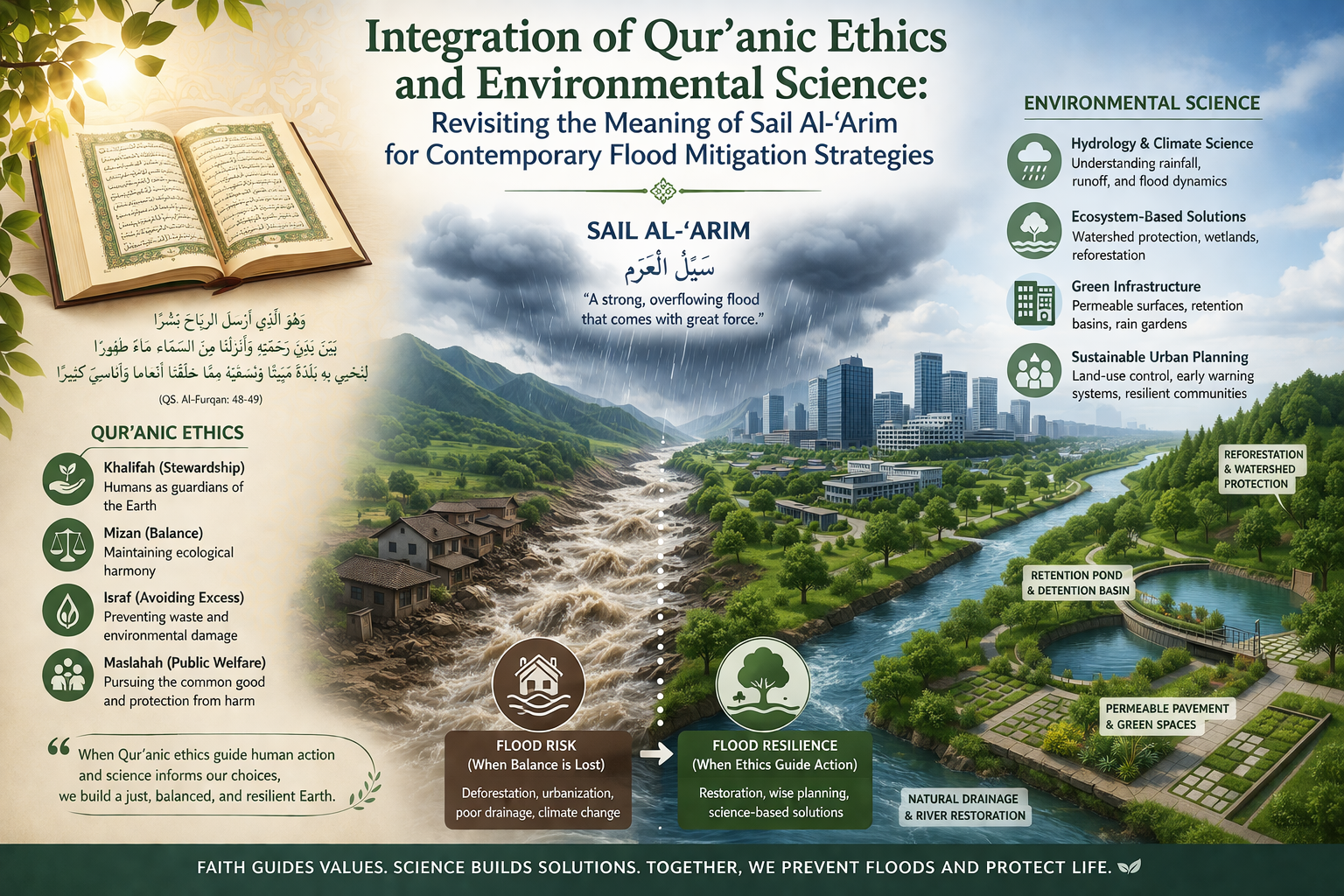
Integration of Qur’anic Ethics and Environmental Science: Revisiting the Meaning of Sail Al -‘Arim for Contemporary Flood Mitigation Strategies
DOI:
https://doi.org/10.69526/qir.v1i1.423Keywords:
Sail al-‘Arim, Izutsu Semantics, Contextual Hermeneutics, Comparative Exegesis, Flood Mitigation, Environmental Ethics.Abstract
Purpose – This study examines the relevance of the Qur’anic narrative of Sail al-‘Arim (QS. Saba’: 16) in addressing contemporary environmental crises and flood disasters. The research aims to reconstruct the theological meaning of the narrative into an ethical and ecological framework applicable to modern disaster mitigation and environmental governance. The study responds to the limited integration of Qur’anic environmental ethics within contemporary sustainability and disaster-risk discourse. Design/methods/approach – The research employs a qualitative library-based method through an interdisciplinary approach. The study combines Toshihiko Izutsu’s semantic analysis, Abdullah Saeed’s contextual hermeneutics, and comparative interpretation between Tafsir al-Qurṭubī and Tafsir al-Azhar. Primary data were obtained from Qur’anic verses and classical-contemporary tafsir literature, while secondary sources included environmental ethics and disaster mitigation studies. Findings – The findings demonstrate that Sail al-‘Arim should not merely be understood as a historical account of divine punishment, but also as a representation of ecological collapse caused by environmental neglect, weak governance, and declining collective responsibility. The study identifies three major ethical principles embedded in the narrative: environmental stewardship, sustainable resource management, and social resilience in disaster preparedness. These principles strengthen non-structural flood mitigation frameworks based on moral awareness and communal responsibility. Research implications/limitations – This study is limited to interpretative and conceptual analysis without empirical field validation. Consequently, the applicability of the proposed ethical framework in practical disaster management remains untested and requires further empirical investigation. Originality/value – The originality of this research lies in its interdisciplinary synthesis of Qur’anic exegesis and environmental studies, positioning the narrative of the Ma’rib dam collapse as a conceptual model for sustainable ecological resilience and faith-based disaster mitigation.